- Where Organizations Usually Stuck?
- How can Azpirantz Simplify the Journey?
- 1. Starting with a Clear DPDPA Readiness Assessment
- 2. Defining Scope, Roles, and Responsibilities
- 3. Building Data Visibility Through Data Mapping
- 4. Simplifying Consent and Privacy Notice Management
- 5. Operationalizing Data Principal Rights
- 6. Aligning Privacy with Cybersecurity Controls
- 7. Strengthening Breach Response and Notification Readiness
- 8. Managing Vendor and Third-Party Risk
- 9. Supporting Cross-Border Data Transfer Governance
- 10. Building a Sustainable Privacy Governance Program
- Why Azpirantz’s Approach Matters for Professionals?
- Conclusion
- FAQs
How Can Azpirantz Consulting Simplify Your DPDPA Compliance Journey?
Privacy is no longer a side project. India had about 1.03 billion internet users by October 2025, IBM says the average cost of a data breach in India reached INR 220 million in 2025, and Cisco reports that privacy spending is rising sharply as organizations turn governance into a strategic capability. In that environment, the Digital Personal Data Protection Act, 2023 and the DPDP Rules, 2025 have moved compliance from legal theory to operational reality.

The law is broad by design. It applies to digital personal data collected in India, can reach organizations processing such data outside India when they offer goods or services to people in India, requires consent to be free, specific, informed, unconditional, and unambiguous, gives individuals rights to access, correction, erasure, grievance redressal, and nomination, and allows significant penalties for non-compliance, including up to ₹250 crore for failing to take reasonable security safeguards. The Rules then add execution detail: clear standalone notices, itemized descriptions of personal data and purpose, breach notifications without delay to affected individuals, and detailed reporting to the Board within 72 hours.
This is the big shift: DPDPA compliance is not won in a policy PDF. It is won in data inventories, consent flows, access controls, vendor contracts, incident playbooks, and evidence trails that stand up when someone asks, “Show me how this works in practice.” This is where Azpirantz Consulting can simplify the DPDPA compliance journey by converting complex regulatory requirements into practical, structured, and business-ready actions.
Most companies do not struggle because the law is unreadable. They struggle because the work is cross-functional. One team owns websites, another owns HR systems, another owns cloud infrastructure, another owns legal notices, and no one owns the full data journey. That creates common challenges such as:
- Unclear roles between Data Fiduciary and Data Processor
- Lack of personal data inventory
- Weak consent collection and withdrawal mechanisms
- Outdated privacy notices
- No defined process for Data Principal rights
- Limited vendor risk visibility
- Unclear breach notification workflows
- Poor evidence of compliance
- Privacy and cybersecurity working in separate silos
DPDPA compliance becomes difficult when every team handles one small part of the puzzle, but no one owns the full picture.
Azpirantz helps simplify this by bringing structure, ownership, documentation, technical control alignment, and continuous governance into one practical roadmap.
Azpirantz simplifies the journey by turning a legal framework into a practical operating model. Start with assessment and scoping. It has a structured approach built around assessments, policy development, data mapping and classification, consent management, breach response, vendor risk, training, compliance monitoring, DSAR support, and cross-border transfer governance. That matters because compliance gets easier the moment the work is sequenced instead of scattered.
Azpirantz appears to simplify DPDPA by sequencing the work, assigning ownership, and turning abstract obligations into repeatable controls and evidence.
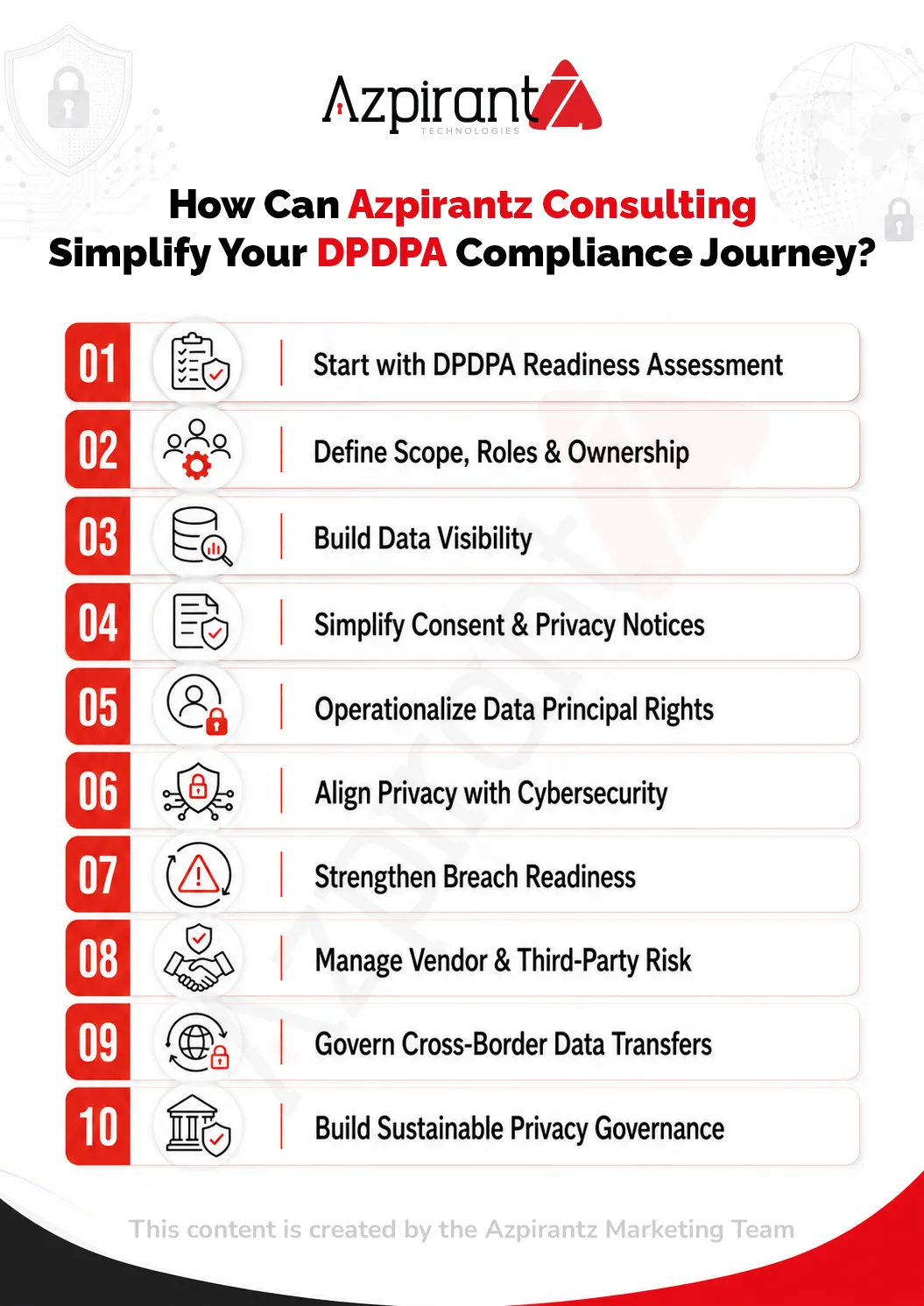
The first step in any compliance journey is understanding where the organization currently stands. Many businesses make the mistake of directly updating policies without first assessing their actual data practices. Azpirantz can help organizations begin with a structured DPDPA readiness assessment. This includes reviewing existing policies, systems, processes, vendors, consent practices, security controls, and privacy governance maturity. This assessment helps answer important questions such as:
- What personal data does the organization collect?
- Is the organization acting as a Data Fiduciary, Data Processor, or both?
- Which departments process personal data?
- Are privacy notices clear and accessible?
- Is consent collected properly?
- Are Data Principal rights supported?
- Are vendors contractually aligned with DPDPA requirements?
- Are security safeguards sufficient?
- Is there a breach response process?
This step simplifies the journey because it gives the organization a starting point. Instead of guessing what to fix, the business gets a clear view of gaps, risks, priorities, and next steps.
DPDPA compliance becomes easier when roles are clearly defined. The Act uses terms such as Data Fiduciary, Data Processor, Data Principal, and Significant Data Fiduciary. These are not just legal labels. They determine accountability.
Azpirantz can help organizations understand their role in different processing activities. For example, a company may act as a Data Fiduciary for its employees and customers, but as a Data Processor when handling data on behalf of another business. This role clarity is important because responsibilities differ based on how personal data is processed. Azpirantz can support organizations in defining:
- Who owns privacy governance internally
- Which teams handle personal data
- Who manages consent and notices
- Who responds to Data Principal requests
- Who handles vendor assessments
- Who coordinates breach response
- Who maintains compliance evidence
This simplifies compliance by removing confusion. When ownership is clear and execution becomes faster.
You can not protect what you can not see. One of the most important parts of DPDPA compliance is understanding the personal data lifecycle. Many organizations collect personal data across websites, CRMs, HR systems, payment tools, learning platforms, cloud applications, analytics tools, and third-party vendors. But this data is often not documented properly.
Azpirantz can help organizations build visibility through data mapping and classification. This may include identifying:
- Types of personal data collected
- Source of data collection
- Purpose of processing
- Legal basis or consent requirement
- Systems where data is stored
- Internal teams with access
- Third parties with whom data is shared
- Retention period
- Deletion or archival process
- Security controls applied
This gives the organization a practical data inventory. It also supports other compliance activities such as consent management, access requests, correction requests, erasure requests, vendor reviews, and breach investigations.
For professionals, this is where DPDPA compliance becomes real. Data mapping turns privacy from a document into an operational capability.
Consent is one of the most visible parts of DPDPA compliance. But it is also one of the areas where organizations often make mistakes.
Under DPDPA, consent must be clear, specific, informed, unconditional, and unambiguous. Users must understand what data is being collected and why. They should also be able to withdraw consent with ease.
Azpirantz can help organizations simplify consent and notice management by reviewing existing user journey and making them more transparent. This may include:
- Creating clear privacy notices
- Aligning consent language with DPDPA expectations
- Avoiding vague or bundled consent
- Designing consent withdrawal processes
- Maintaining consent records
- Making notices accessible and easy to understand
- Connecting consent choices with backend systems
The goal is simple: users should not feel trapped, confused, or misled.
A strong consent system does more than reduce compliance risk. It builds trust. When people understand how their data is used, they are more likely to trust the organization.
DPDPA gives individuals rights over their personal data. These may include access, correction, updating, erasure, grievance redressal, and nomination. The challenge is not just knowing these rights exist. The challenge is building a process to handle them.
Azpirantz can help organizations create structured workflows for Data Principal rights. This includes defining request channels, internal routing, response ownership, verification steps, timelines, documentation, and escalation mechanisms. A practical rights management process should answer:
- How can a Data Principal submit a request?
- Who receives the request?
- How is identity verified?
- Which systems need to be checked?
- Who approves correction or erasure?
- How is the response documented?
- How are grievances escalated?
Without a defined workflow, rights requests can become chaotic. With Azpirantz’s guidance, organizations can create repeatable and auditable processes that support compliance and improve user trust.
For a cybersecurity audience, this is one of the most important parts of the DPDPA journey. DPDPA is not only about legal compliance. It also expects organizations to implement reasonable security safeguards. That means privacy and cybersecurity must work together. Azpirantz can help connect privacy obligations with existing security controls such as:
- Access control
- Encryption
- Data masking
- Tokenization
- Logging and monitoring
- Backup and recovery
- Incident response
- Vulnerability management
- Vendor security checks
- Security awareness training
This is where Azpirantz’s broader expertise in data privacy, cybersecurity, risk management, and business continuity becomes useful. Instead of treating privacy as a separate legal project, organizations can integrate DPDPA requirements into their existing security and governance programs.
This simplifies compliance because security teams do not need to start from zero. They can map DPDPA requirements to controls they already understand and operate.
A personal data breach can create legal, operational, financial, and reputational damage. Under DPDPA, organizations must be prepared to respond quickly and responsibly. Azpirantz can help organizations improve breach readiness by aligning privacy obligations with incident response processes. This may include:
- Defining what qualifies as a personal data breach
- Creating breach escalation workflows
- Identifying internal response teams
- Preparing notification templates
- Documenting investigation steps
- Coordinating legal, security, and communication teams
- Maintaining breach records
- Conducting table top exercises
This simplifies the journey because organizations do not have to create a separate breach response process for privacy. Instead, privacy breach response can be integrated into the existing cybersecurity incident response framework.
Most organizations do not process personal data alone. They rely on cloud providers, SaaS platforms, payment processors, HR tools, marketing platforms, consultants, and other service providers.
Under DPDPA, vendor governance becomes critical because third parties may process personal data on behalf of the organization. Azpirantz can help organizations simplify third-party risk management by reviewing vendor relationships and ensuring that privacy and security expectations are clearly defined. This may involve:
- Identifying vendors that process personal data
- Reviewing vendor security practices
- Updating contracts and data processing agreements
- Defining processor obligations
- Applying data minimization principles
- Monitoring vendor compliance
- Reviewing cross-border data transfers
- Maintaining vendor risk documentation
This is important because privacy risk does not stop at the organization’s boundary. If a vendor mishandles personal data, the organization may still face consequences.
Many businesses operate across geographies or use global cloud and SaaS platforms. This means personal data may move across borders. Azpirantz can help organizations understand and manage cross-border data transfer risks by mapping international data flows, reviewing transfer mechanisms, checking vendor locations, and monitoring applicable regulatory conditions. This helps organizations avoid blind spots in global data movement.
For businesses operating across India and international markets, this is especially useful because privacy compliance can not be handled country by country in isolation. A unified privacy governance framework helps reduce duplication and confusion.
DPDPA compliance is not a one-time project. It is an ongoing governance responsibility. Azpirantz can help organizations build sustainable privacy programs through continuous monitoring, training, audits, documentation, policy updates, and vDPO-led support. This may include:
- Employee privacy awareness sessions
- Role-based training for HR, IT, marketing, and support teams
- Periodic compliance reviews
- Policy and process updates
- Internal audits
- DPIAs where required
- Evidence maintenance
- Management reporting
- Continuous improvement plans
This makes compliance more manageable because the organization does not have to restart the process every time a regulation changes, a new system is launched, or a new vendor is onboarded.
For professionals, the biggest value of Azpirantz Consulting is not just legal interpretation. It is practical execution.
Azpirantz can help bridge the gap between privacy law and business operations. That matters because DPDPA compliance requires more than understanding the Act. It requires implementing it across systems, people, processes, vendors, and controls.
A professional audience should see Azpirantz as a consulting partner that can help with:
- Converting legal requirements into practical action plans
- Connecting privacy with cybersecurity and risk management
- Building documentation and evidence trails
- Reducing confusion between teams
- Supporting leadership with structured governance
- Improving readiness for audits, complaints, and breaches
- Making privacy part of daily operations
Azpirantz helps organizations move from “What does the law say?” to “How do we actually implement this?”
DPDPA compliance can feel complex because it touches almost every part of an organization. It involves legal obligations, cybersecurity controls, consent flows, vendor contracts, employee awareness, data inventories, breach response, and continuous governance.
But the journey becomes simpler when it is structured.
Azpirantz Consulting can simplify DPDPA compliance by helping organizations assess their current readiness, define roles, map personal data, improve consent and notice mechanisms, operationalize Data Principal rights, align privacy with security controls, manage vendors, prepare for breaches, and build an ongoing privacy governance program.
The real value lies in turning DPDPA from a legal checklist into a practical, business-ready privacy framework.
And that is exactly what modern organizations need: not just compliance on paper, but privacy that works in practice.
1. What is DPDPA compliance in India?
- DPDPA compliance means aligning your organization with the Digital Personal Data Protection Act, 2023, and the DPDP Rules, 2025. In practice, that includes lawful processing, clear notices, valid consent where required, support for Data Principal rights, reasonable security safeguards, breach reporting, and accountable governance.
2. Who needs to comply with the DPDP Act?
- Any organization handling digital personal data connected to offering goods or services to individuals in India may fall within scope, including entities outside India. Businesses also need to determine whether they act as a Data Fiduciary, a Data Processor, or may later be notified as a Significant Data Fiduciary.
3. What are the first steps for DPDPA compliance?
- Start with a data inventory, role mapping, lawful-purpose review, consent and notice design, rights-handling workflows, and a gap assessment of security and vendor controls. That sequence is reflected both in the Act’s obligations and in Azpirantz’s own DPDPA readiness guidance.
4. How can Azpirantz help with DPDPA compliance?
- Azpirantz can help organizations simplify DPDPA compliance through readiness assessments, data mapping, policy development, consent management, rights request workflows, security control alignment, breach response planning, vendor risk management, employee training, and continuous governance support.
5. Is DPDPA only a legal compliance requirement?
- No. DPDPA is also a cybersecurity, governance, and trust requirement. Organizations must not only create privacy policies but also implement security safeguards, manage access, monitor systems, handle breaches, govern vendors, and maintain evidence of compliance.
We're Here To Help